
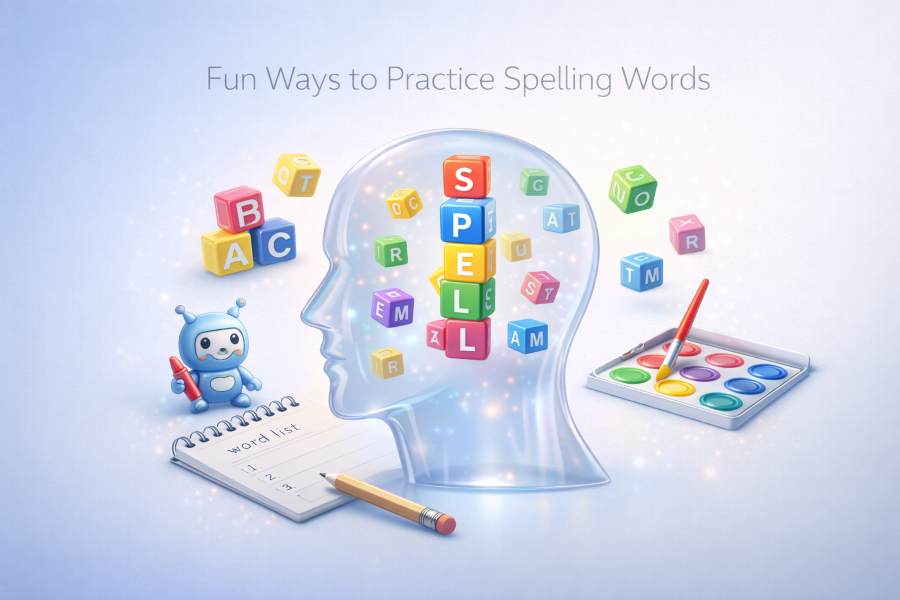
For decades, the "Friday Spelling Test" has been a source of anxiety for students and a repetitive chore for parents. The traditional method—writing a word ten times until it sticks—is not only monotonous but scientifically inefficient. It relies on rote memorization, which often bypasses the brain's deeper processing centers, leading to words that are forgotten as quickly as they were learned.
The secret to long-term orthographic retention lies in multi-sensory engagement. When a child connects a word to a physical movement, a visual burst of color, or a competitive game, they are building multiple neural pathways to that single piece of information. This is the difference between "renting" a word for a test and "owning" it for life.
In this comprehensive guide, we move beyond the worksheet. We explore fun ways to practice spelling words that tap into kinesthetic, auditory, and visual learning styles, transforming a dull study session into the highlight of your child’s day.
Neurologists have found that the brain's hippocampus (the center for memory) is significantly more active when a task is paired with novel stimuli or physical activity. By turning spelling into a game, you lower the child's "affective filter"—a psychological barrier caused by stress—allowing information to flow into long-term storage more effectively.
Active & Kinesthetic: Moving While Spelling
Some children are "movers." They think better when their bodies are engaged. For these kinesthetic learners, sitting still is actually a cognitive tax. Use these high-energy games to burn off steam while building brainpower.
Basketball Spelling
For every letter spelled correctly, the child earns a shot at a laundry basket or hoop. If they miss a letter, they have to dribble while reciting the word again. It connects rhythm to orthography.
Scavenger Hunt
Hide the letters of a word around the house. The child must find the letters and assemble them in the correct order on the kitchen table before moving to the next word on the list.
Stair Step Spelling
The child starts at the bottom of the stairs. For every letter they get right, they move up one step. The goal is to reach the "summit" by finishing the word correctly. If they fail, they retreat two steps.
Balloon Volley
Keep a balloon in the air. Each time the child hits it, they must shout the next letter of the spelling word. This requires intense focus and rapid recall under physical pressure.
Tennis Ball Bounce
Bounce a ball against a wall or the floor. Each bounce represents a letter. This rhythmic movement helps internalize the "beat" of longer, multi-syllabic words.
Body Letters
For younger children, have them use their entire body to "form" the shape of the letters as they spell them out. This gross motor activity creates a strong visual-physical connection.
Artistic & Sensory: Tactile Spelling Crafts
Tactile learning involves the sense of touch. By using different textures, children create a sensory "map" of the word in their minds. This is particularly effective for children who struggle with traditional pencil-and-paper tasks.
- Shaving Cream Writing: Spread a thin layer of shaving cream on a baking tray. Let the child write their words with their finger. The sensory input of the cream makes the activity memorable and fun.
- Pipe Cleaner Constructions: Have the child bend pipe cleaners into the shapes of the letters. Physically "building" the word helps them see how the letters relate to one another spatially.
- Squishy Word Bags: Fill a Ziploc bag with hair gel and food coloring. Tape it to a window. The child "writes" the word on the bag, watching the gel move. It is a mess-free sensory experience.
- LEGO Building: Use a permanent marker to write letters on the sides of LEGO bricks. The child must "click" the blocks together to construct their spelling list.
Creative & Visual: Seeing the Words Differently
Visual learners need to see patterns, colors, and shapes. These methods transform a list of black-and-white text into a vibrant, multi-colored map of linguistic information.
Rainbow Writing
The child writes the word once in pencil, then traces over it in every color of the rainbow. The repeated tracing builds muscle memory while the colors keep the brain alert.
Invisible Ink
Use a white crayon to write the word on white paper. Then, have the child paint over it with watercolors. The word "magically" appears, creating a powerful visual anchor.
Flashlight Tag
Tape words to the wall. Turn off the lights. Call out a word, and the child has to find it with the flashlight beam and spell it out loud while it's illuminated.
Word Surgery
Write words on strips of paper and "cut" them into syllables. The child must act as the surgeon and tape the "patient" back together in the correct order.
Ransom Notes
Give the child an old magazine and a pair of scissors. They must find the letters they need to spell their words, cut them out, and glue them down like a movie ransom note.
Chalk Walk
Write the spelling words in giant letters on the driveway. Have the child "walk" the word, stepping on each letter as they say it out loud.
The Psychology of Spelling: Building Confidence
Beyond the games, the way we approach spelling practice emotionally matters just as much as the activities themselves. If a child feels judged or pressured, their brain enters "survival mode," which shuts down the centers responsible for language acquisition.
The Power of "Self-Correction": Instead of crossing out a wrong word with a red pen, ask the child: "Something looks a bit funny with that word; can you find the tricky part?" This encourages them to develop their "internal spell-checker," a skill used by all proficient writers.
Focus on Morphemes: Instead of memorizing 20 random words, teach the "building blocks." If they know how to spell "play," they can easily learn "player," "playing," "playable," and "playful." This reduces the total amount of "new" information they need to store.
Spelling Sabotage: 6 Mistakes to Avoid
Even with the best intentions, certain habits can actually make spelling harder for children. Recognizing these pitfalls is essential for creating a productive learning environment.
Over-Correcting
Fixing every mistake in a child's creative writing kills their desire to write. During "spelling time," focus on spelling. During "story time," focus on ideas.
Marathon Sessions
The brain stops absorbing new data after about 20 minutes. Three 10-minute "bursts" of practice are infinitely better than one grueling hour-long session.
Speed Over Accuracy
Don't rush the child. Spelling is a process of retrieval. If you push for speed too early, they will rely on guessing rather than actually processing the letters.
Boring Lists
If the words are completely irrelevant to the child's life, they won't care. Try to include "bonus words" that relate to their hobbies or interests (e.g., "Minecraft" or "Gymnastics").
Ignoring Phonemes
Spelling is the mapping of sounds to symbols. If you don't talk about the sounds (phonemes), the child is just memorizing a random string of shapes.
Negative Reinforcement
Avoid red pens and "No." Use highlighters to mark what they got right. If they got 4 letters out of 5, celebrate the 4 and work on the "tricky" 5th one.
Conclusion: Transforming the Friday Dread
The best way to teach spelling isn't through a textbook; it's through the heart and the hands. By incorporating movement, art, and play, you are doing more than helping a child pass a test—you are giving them the tools to express themselves with confidence for the rest of their lives.
Every child is different. Some will love the "Basketball Spelling," while others will find peace in "Rainbow Writing." Experiment with these methods, find what sparks a smile, and remember that progress is more important than perfection. Spelling is a journey of discovery, and with the right approach, it can be a joyful one.
Frequently Asked Questions
How many spelling words should we practice at once?
For most primary-aged children, a list of 10 to 15 words per week is standard. However, it's better to master 5 words completely than to vaguely know 20. Quality and retention are always superior to quantity.
What if my child is frustrated and refuses to practice?
Stop immediately. Frustration shuts down the learning centers of the brain. Switch to a high-movement game like "Balloon Volley" or take a 20-minute break. Learning cannot happen in a state of high stress.
Should we use spelling apps and digital games?
Digital tools like Spelling City or Duolingo ABC are excellent supplements. They provide instant feedback and high engagement. However, they should be balanced with tactile, "off-screen" activities to ensure multi-sensory development.
How do I help a child with dyslexia learn spelling?
Children with dyslexia benefit significantly from "Structured Literacy" and multi-sensory methods. Use tactile materials like sand and pipe cleaners, and focus heavily on phonics—understanding how sounds map to letters.
Does reading more improve spelling?
Yes. Reading provides "input." The more a child sees a word correctly spelled in a book, the more they build their visual "mental dictionary." However, reading is passive; spelling is active, so both are necessary for mastery.